Is Radiology Technician a Good Career? Pros and Cons (2026)
See if you qualify for Radiology Technician programs
Answer a few questions in 2 minutes. Free, no commitment.
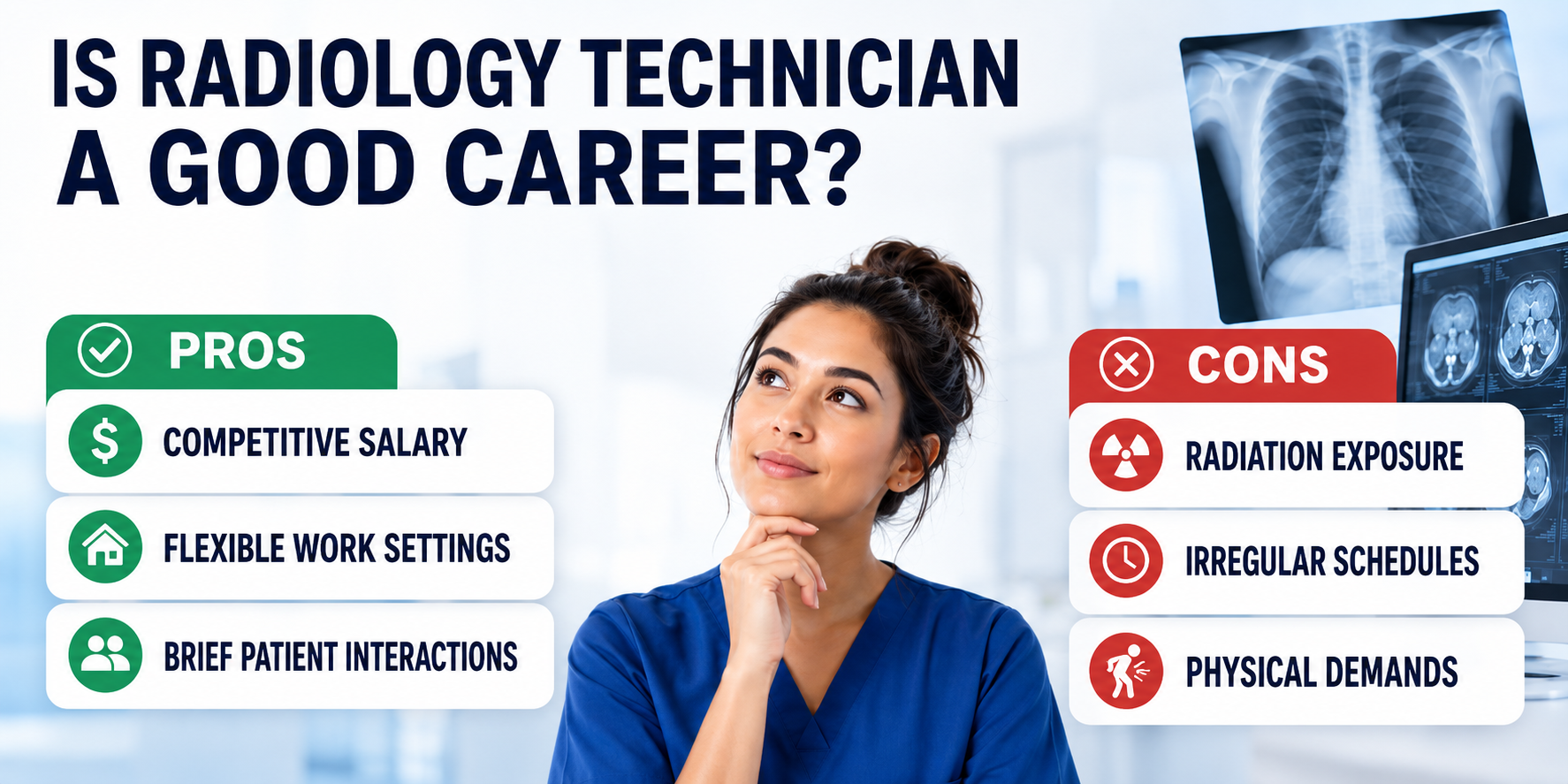
For most people considering it, radiology technician is a good career: it pays a median of $77,660 a year, needs only about two years of training, and has steady demand across hospitals and clinics. The trade-offs are real, though. You will stand for long shifts, work some nights and weekends, follow strict radiation-safety routines, and keep up with continuing education for the life of the career. Whether it is right for you comes down to how you weigh stable, hands-on healthcare work against those physical and scheduling demands. Both sides are laid out below with verified 2026 numbers.
Radiology Technician Salary and Job Outlook
The BLS reports a median annual wage of $77,660 for radiologic technologists and technicians as of May 2024, about $37.34 per hour. New graduates typically start lower, with the bottom 10% earning under $52,360, and pay climbs with experience until the top 10% earn more than $106,990. Pay is also highest in high-cost states; California, for example, averages around $103,150 a year (BLS OEWS, May 2024), though cost of living offsets some of that advantage.
BLS projects 4% employment growth from 2024 to 2034 for radiologic technologists and technicians, with thousands of openings each year, on average, over the decade. Pay also rises with specialization: MRI technologists earn a median of $88,180, and adding credentials in CT, mammography, or interventional imaging is a common way to move up.
Who Radiology Technician Work Suits Best
A quick gut check before you commit to training.
This career likely suits you if you:
- Want hands-on healthcare work without a four-year degree or medical school
- Are comfortable on your feet and physically active through a shift
- Can handle some nights, weekends, or on-call time
- Like steady, technical routine work with room to specialize later
It may not suit you if you:
- Want a desk-based or fully predictable nine-to-five schedule
- Prefer to avoid physically demanding work
- Would rather not manage radiation-safety routines daily
- Want to stop formal learning once you are credentialed
How to Become a Radiology Technician
The standard path takes about two years.
- Finish an accredited program. Most technicians earn an Associate of Applied Science (AAS) degree, with in-state tuition commonly between $10,000 and $18,000. A faster limited-scope certificate (about 8 months) is an option in some states for a narrower x-ray role.
- Get certified and licensed. After graduating, you sit for the American Registry of Radiologic Technologists (ARRT) exam, which most states require for licensure. The primary application and exam fee is $225. Once you are credentialed, you can create a resume that reflects your clinical training and ARRT credential.
Not sure which path to choose? The limited-scope certificate is faster and cheaper but qualifies you for a narrower x-ray role, while the AAS degree takes longer and opens the full range of imaging careers through ARRT certification. For full ARRT eligibility, the program should be accredited (JRCERT for a degree).
You can compare accredited radiology technician programs by cost, length, and format on Dreambound, and if speed or budget is your priority, see the guide to the cheapest and fastest radiology technician programs.
Accredited programs worth comparing:
CCI Training Center: Radiology Technician Training
- Online with local clinical rotations; 8-month limited-scope certificate
- ACCET-accredited; prepares students for ARRT Limited Scope certification
CCI Training Center: Radiology Tech Training (Hybrid)
- The same 8-month program in a flexible, modular format
- ACCET-accredited; prepares students for ARRT Limited Scope certification
ECPI University: Medical Radiography Associate's
- Hybrid AAS in as little as 18 months
- JRCERT-accredited; graduates are eligible for the ARRT national exam
Frequently Asked Questions
What are the cons of being a radiology technician?
The main drawbacks are physical strain from standing and lifting patients, daily radiation-safety precautions, and non-traditional schedules that can include nights, weekends, and on-call shifts. The work can also be emotionally taxing when patients are in pain or seriously ill, and the field requires ongoing continuing education to keep your certification current.
How much do radiology technicians make in the US?
Radiologic technologists and technicians earn a median annual wage of $77,660, or about $37.34 per hour, as of May 2024 (BLS). New graduates usually start under $52,360, and the top 10% earn more than $106,990. Pay rises with specialty certifications, experience, and location, with the highest wages in high-cost states like California.
Is radiology in demand in the US?
Yes. BLS projects about 4% employment growth from 2024 to 2034 for radiologic technologists and technicians, with thousands of openings each year, on average, over the decade. Demand is driven by an aging population that needs more diagnostic imaging and by the steady need to replace workers who retire or change fields.
Will AI replace radiology technicians?
It is unlikely in the foreseeable future. AI tools increasingly help read and flag images, but they do not position patients, operate equipment, or manage the hands-on, in-person care that imaging requires. AI is more likely to assist radiology technicians than to replace them, though staying current with new technology is part of the job.
What is the highest-paying job in radiography?
Among related imaging roles, nuclear medicine technologist is one of the highest paying, with a median wage of $97,020 a year as of May 2024 (BLS). Within radiologic technology itself, MRI technologists (median $88,180) and technologists who add CT, mammography, or interventional credentials typically earn the most.
Is Radiology Technician Right for You?
Radiology technician is a good career for people who want hands-on healthcare work, solid pay, and a clear path in without a four-year degree, and who are comfortable with physical, shift-based work and ongoing learning. It is a weaker fit if you want predictable desk hours or prefer to avoid physical demands.
If the trade-offs sound workable, the next step is choosing an accredited program. Compare radiology technician programs by cost, length, and format on Dreambound to find one that fits your timeline and your state's requirements.