Is Medical Billing and Coding Worth It? Pros and Cons (2026)
See if you qualify for Medical Assistant programs
Answer a few questions in 2 minutes. Free, no commitment.
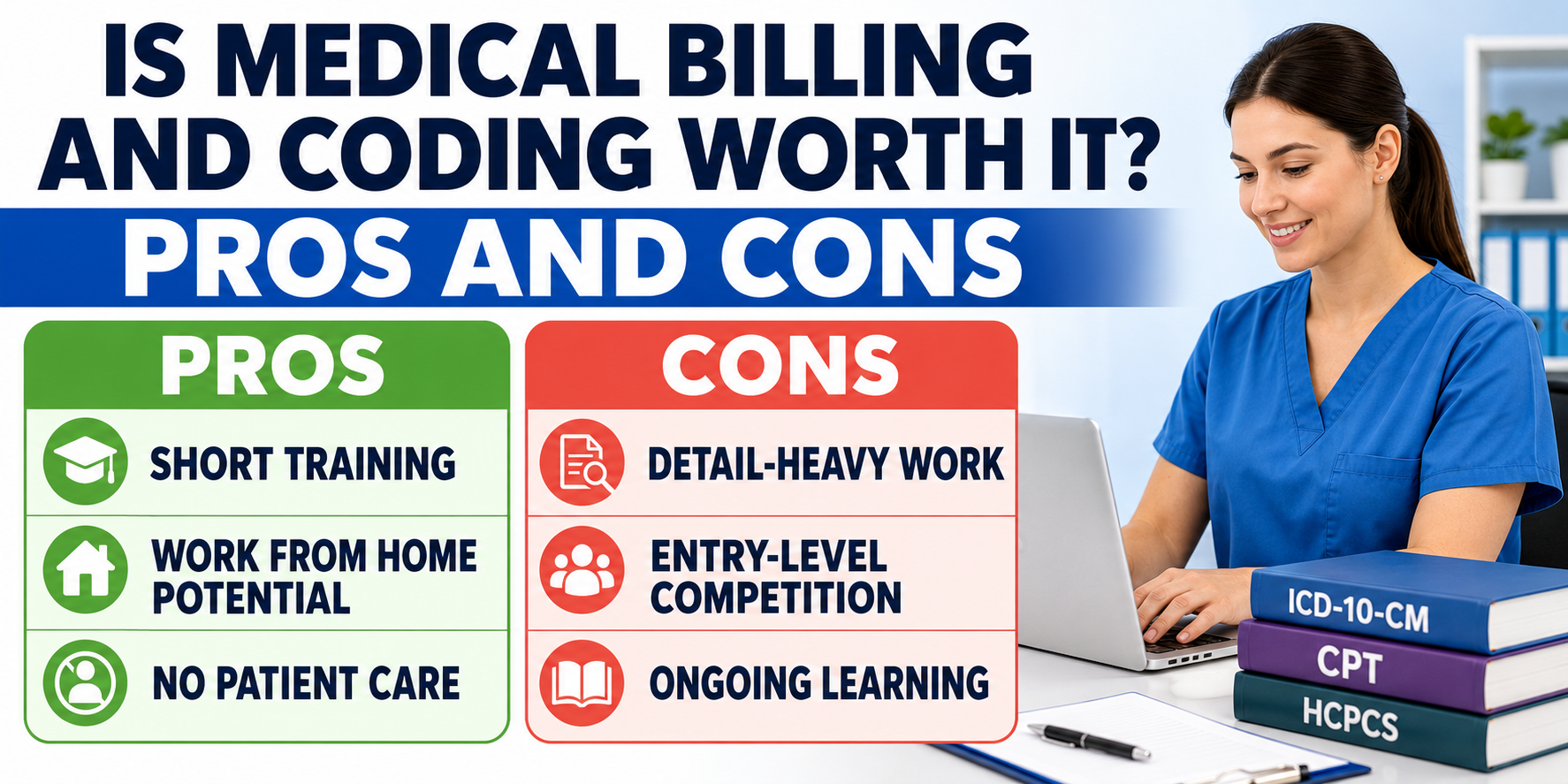
Medical billing and coding is worth it for the right person: the training is short, the work is steady, and remote roles are more common here than in almost any other healthcare job. BLS projects about 14,200 openings a year for medical records specialists through 2034, faster than the average for all occupations, with a median wage of $50,250. The catch is real, too. The work is detail-heavy and repetitive, entry-level hiring is competitive, and AI is changing what the job involves day to day. Whether it is worth it for you comes down to how well that work suits the way you like to work, and whether you plan to keep building skills as the field shifts.
Medical Billing and Coding - Penn Foster
- Format: Online, self-paced
- Length: about 10 to 14 months
- Tuition: $59 per month, with a start as low as $20 down
- Prepares for the NHA Certified Billing and Coding Specialist (CBCS) exam, with the exam fee and prep covered for graduates
Associate's Degree Programs
A.S. Medical Billing and Coding - Ultimate Medical Academy
- Format: Online
- Length: 18 months
- Prepares for the AAPC Certified Professional Coder (CPC) exam
- ABHES-accredited
Associate of Science in Medical Coding - Herzing University
- Format: Online
- Length: a minimum of 60 semester credit hours
- Covers the CPT, ICD-10-CM/PCS, and HCPCS coding systems
Compare these and other programs on Dreambound to weigh length, credential, and total cost against your goals.
Frequently Asked Questions
Is it better to be a medical biller or coder?
Neither is universally better, and the right pick comes down to what you enjoy. Coding focuses on assigning diagnostic and procedure codes from documentation, while billing focuses on building claims, submitting them, and working denials. Many roles, especially in smaller offices, combine both. Coding rewards detail focus; billing leans more on follow-up and payer communication.
What is the hardest thing about medical billing and coding?
Most people point to accuracy under pressure. A single miscode can cause a denied claim, a delayed payment, or an audit, and many roles set daily productivity targets on top of that. Keeping up with frequent code and payer-rule changes is the other common challenge people name.
Is medical billing and coding a stressful job?
It can be, though the stress is usually steady rather than acute. The main pressure points are productivity quotas, accuracy expectations, and deadline-driven claim cycles. Hospital inpatient coding tends to be more complex than physician-office work. Many coders describe the pace as manageable once they have experience.
Do you need a degree to work in medical billing and coding?
No. Most people enter through a certificate or diploma program and then sit for a certification exam such as the AAPC CPC, AHIMA CCA, or NHA CBCS. An associate degree can open more doors faster, especially for supervisory or health information roles, but it is not the standard entry requirement.
Can medical billing and coding be done from home?
Yes, more so than most healthcare roles. Many billing and coding jobs are fully remote for hospitals, billing companies, and payers. Fully remote positions usually favor candidates with experience, so many new graduates start on-site or hybrid and move remote after building a track record.
Which medical billing and coding certification is best?
The right certification depends on the setting you want to work in. The AAPC CPC is the most common credential for physician-office and outpatient coding, the AHIMA CCS is the standard for inpatient hospital coding and often carries higher pay, and the NHA CBCS is broader and offered through more programs. Compare programs on Dreambound to see which credential each one prepares you for.
Choosing Your Path in Medical Billing and Coding
Medical billing and coding is changing rather than disappearing. Automation now handles the routine, well-documented coding, while the work that pays and lasts is the judgment-heavy part: complex cases, denials, audits, and keeping current as the rules modernize. That is why the field still suits a specific person, someone comfortable with detailed, screen-based work who treats certification and ongoing learning as part of the job rather than a one-time step.
From there, the next move is matching a program to your budget and timeline. Dreambound lets you compare accredited options side by side, by the credential each one targets and the total cost with the certification exam included, so you can see which path fits before you commit.