Is EKG Technician a Good Job? Pros and Cons (2026)
See if you qualify for Electrocardiogram (ECG/EKG) programs
Answer a few questions in 2 minutes. Free, no commitment.
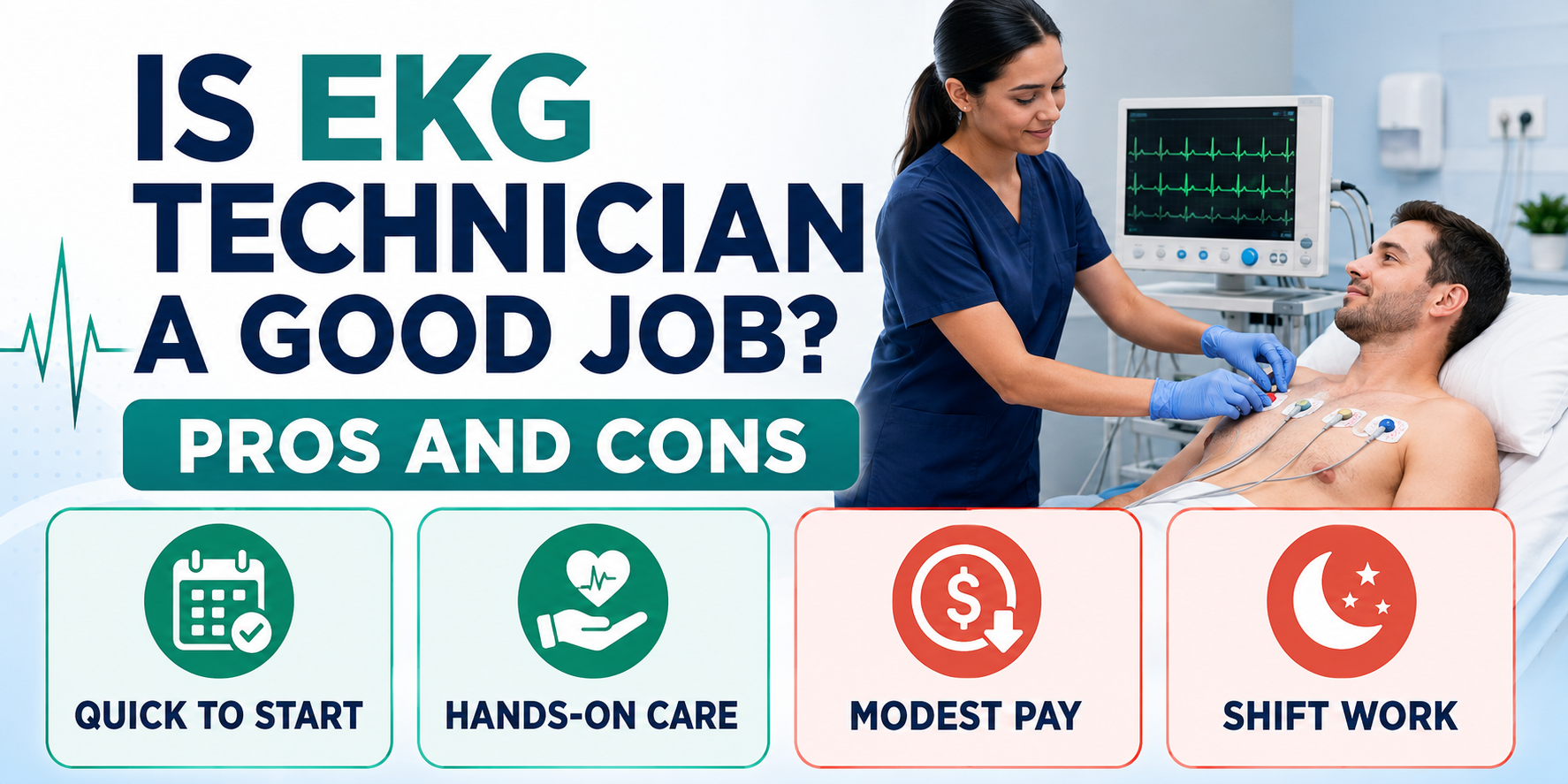
Is EKG technician a good job? For the right person, yes. It is one of the shortest, cheapest routes into clinical healthcare: you run electrocardiogram tests that record a patient's heart activity, then hand the results to a physician to read. But the honest picture is more layered than most career pages admit. Entry pay is modest, the standalone role has a real ceiling, and the Bureau of Labor Statistics projects only 3% job growth through 2034, even as student interest in the training climbs fast. Whether it is a good job for you comes down to what you want from a healthcare career, and the honest pros and cons below should make the call clearer.
ECG - Intelvio
A $995 in-person program with hands-on lead placement and live ECG practice, offered at Riverside and also at Manteca, National City, and Mission Viejo.
If you would rather build broader lab skills at once, Dreambound also lists combined Laboratory Assistant, EKG, and Phlebotomist certificates that bundle EKG with lab work and phlebotomy and run about nine months.
Frequently Asked Questions
Is being an EKG technician a good job?
For people who want fast, affordable entry into clinical healthcare and like defined, hands-on work, yes. The trade-offs are honest ones: entry pay is modest, often $39,000 to $48,000, advancement usually means adding credentials, and hospital roles can include nights and weekends. If those fit your goals, it is a solid starting career.
Is being an EKG technician a stressful job?
It varies sharply by setting. Outpatient and clinic roles are calmer because tests are scheduled and patient flow is predictable. Hospital and emergency positions run higher, especially when stat EKGs are ordered on critically ill patients. Over time, the emotional weight of working with cardiac patients tends to matter more than minute-to-minute pressure.
Can you work as an EKG technician without a college degree?
Yes. The role does not require an associate or bachelor's degree. Most employers ask for a high school diploma or equivalent, completion of a short EKG training program, and a recognized certification such as the NHA CET or NCCT NCET. The credential is the gating step, not a college education.
Who makes more money, a CNA or an EKG technician?
EKG technicians usually earn more than certified nursing assistants, though the gap depends on the role and local market. The broader cardiovascular group had a $74,310 median in May 2025, with standalone EKG roles lower in that range. The CNA versus EKG comparison weighs schedules, renewal, and advancement, not just pay.
Is EKG technician or phlebotomy a better starting point in healthcare?
It depends on the path you want. Phlebotomy training is often shorter and cheaper, with broad entry-level demand across labs and clinics. EKG takes about the same time but opens a cardiology-adjacent route with a higher ceiling if you keep going. The EKG versus phlebotomy comparison covers the day-to-day differences and pay paths.
Choosing EKG Technician Training
EKG technician work suits a specific kind of person: someone who wants a quick, low-cost start in clinical care, is comfortable with a defined scope and some shift work, and treats the credential as a first rung rather than the whole ladder. If that is you, the modest starting pay and slow employer-side growth are fair trade-offs for how quickly you can be working and earning.
The next move is to compare your real options and choose deliberately, weighing each program against your budget, your schedule, and the certification you want to earn.